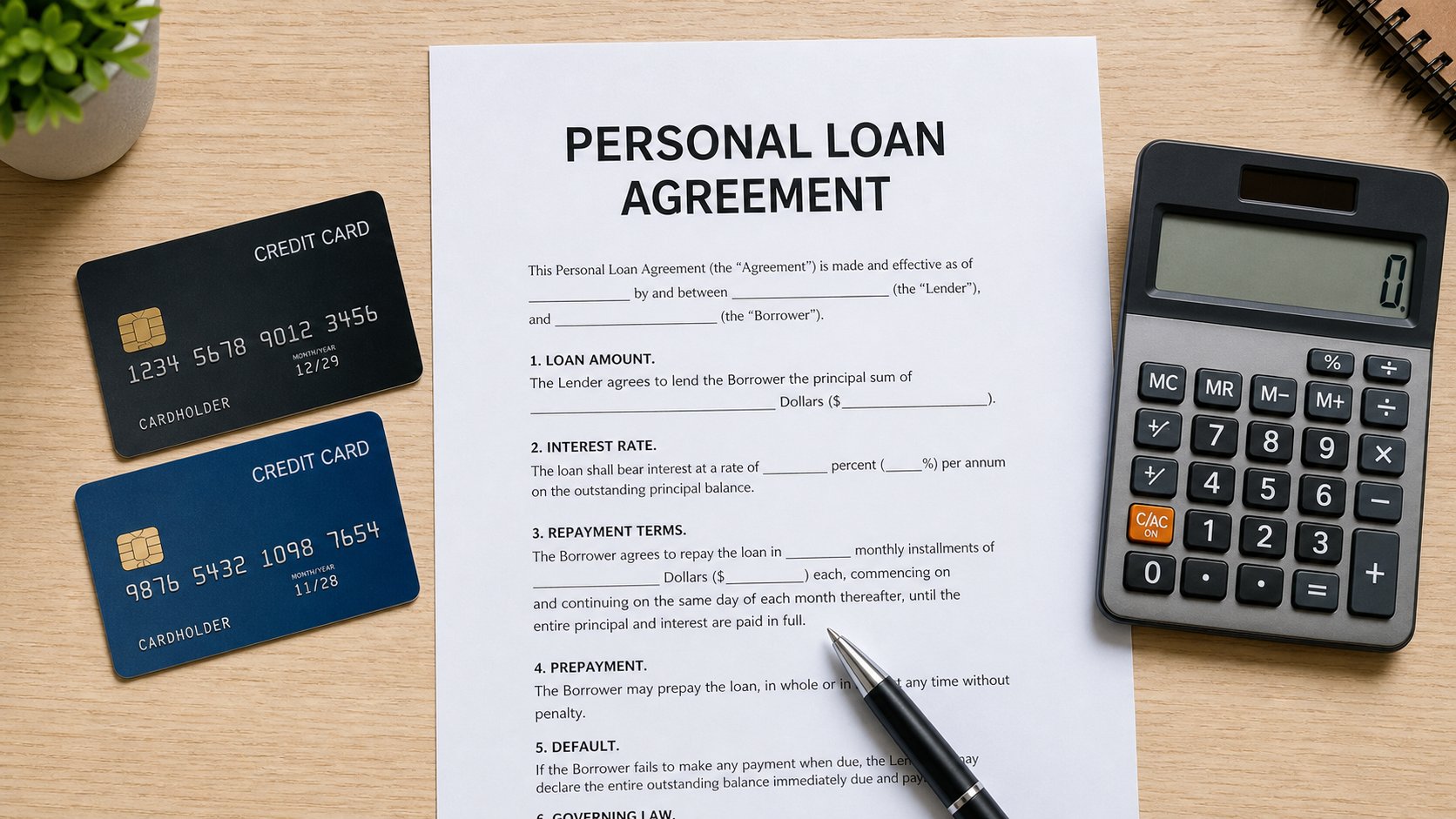
You need $8,000 for a home repair — or $15,000 to consolidate three revolving balances. The two most common answers are the personal loan and the credit card, and both will get you the money. They will not get you the same cost, the same term, or the same impact on your credit. Choosing between them without doing the math is how people end up paying $3,000 or more in extra interest. Here is how our advisors compare the two, category by category.
Cost: Fixed vs. Variable by Design
A personal loan comes with a fixed interest rate locked at closing. A $10,000 loan at 9.5% APR over 36 months is exactly $10,245 of interest, whether the Federal Reserve cuts rates next month or hikes them. You know the total on day one, and your payment never moves.
Credit cards work the opposite way. Card APRs typically run 19% to 29%, and they are variable — they can climb with the benchmark rate, and they always have. A $10,000 balance at 24% paid over 36 months with only minimum payments can cost well over $6,000 in interest and take far longer to clear. The card only wins on cost in one scenario: you pay the balance in full every single month and owe no interest at all.
The honest rule we give clients: if you will carry a balance for more than one billing cycle, a personal loan is almost always cheaper.
Term and Cash Flow
Loans stretch the obligation across 12 to 72 months, so the monthly payment on $10,000 might be $320. Cards demand (on paper) the full balance by the due date, and paying only the minimum — usually 1% to 3% of the balance — keeps you deep in interest for years. If your cash flow is tight this year, the loan's long, level payment is the gentler structure. If your cash flow is strong and predictable, the card gives you interest-free float on every purchase you settle in full.
Impact on Your Credit Score
Both generate a hard inquiry when you apply, and both report payment history. Where they diverge is utilization: a $10,000 balance on a card with a $10,000 limit is 100% utilization — a severe score drag, often 60 to 90 points — until it is paid down. The same $10,000 on a personal loan touches utilization not at all; installment loans barely register in the score formula. One more subtlety: when you refinance card debt into a personal loan, your average age of credit can drop slightly as the card closes. We usually keep the card open at a zero balance to protect the history.
Fees and Fine Print
Read the fee schedules side by side before signing. Common loan-side costs: origination fees of 1% to 8% (sometimes deducted from your proceeds), and — at some lenders — prepayment penalties. Common card-side costs: cash-advance APRs of 25%+ with a 3% fee (never put a loan onto a card as a cash advance), balance-transfer fees of 3% to 5%, annual fees of $95 to $695, and foreign transaction fees if you travel.
A loan with a 4% origination fee can still beat a card with no fee but a 26% APR. Always compute the total cost of the money, not the sticker APR.
Speed and Access
Cards win on convenience: if you have available limit, the money is already in your pocket. Personal loans take a real application — income verification, a credit pull, and typically one to three business days for funding, though some partners fund same-day. For planned expenses, that lead time is a feature, not a bug: it forces the paperwork that keeps the rate honest.
The Verdict From Our Desk
- Take the personal loan when you are financing a known lump sum (repair, medical, education, consolidation), when you need the payment to stay level for a year or more, or when your card utilization is already above 30%.
- Take the credit card when you pay in full every month, when the amount is small and temporary, or when you are running a specific balance-transfer offer at 0% APR for a defined window — and you commit to clearing it before the promotional rate expires.
- Never use a cash advance as a shortcut. It is the most expensive form of borrowing in consumer finance.
Bring both options to a free consultation and we will run your exact numbers — loan vs. card, fee by fee — so the decision is arithmetic, not a guess.